Pages

Sunday, 17 August 2014

2nd Rough Cut


Task: Embed 2nd roughcut. Provide audience feedback (it is not enough to just do questionnaires – you will need to interpret these questionnaires by providing analysis of results through pie charts and bar graphs) – idea for feedback would be to embed film and use survey monkey to ask your audience – state clearly who needs to answer questions – what improvements will you make based on feedback given?

Screen shots of edit – discuss difficulties and how you are overcoming them.


How are your skills improving over time?

Roles and Responsibilities


 Task: Create 3 subheadings  pre-prod/prod and post prod – write what your role was for each of these was.

It is essential that your posts are delivered in this order so it is easy for the examiner to find your key pieces of work

Evaluation Questions


Evaluation Questions


1. In what ways does your media product use, develop or challenge forms and conventions of real media products? (i.e. of film openings)

2. How does your media product represent particular social groups ?

3. What kind of media institution might distribute your media product and why?

4. Who would be the audience for your media product?

5. How did you attract/address your audience?

6. What have you learnt about technologies from the process of constructing this product?

7. Looking back at your preliminary task (the continuity editing task), what do you feel you have learnt in the progression from it to full product?


Each question is to be a post. Make sure the title of the post is the question and its number so it is easy for the examiner to locate. The questions need to be in the same order as shown above. 

It would be beneficial to do a group Director’s commentary for one of the evaluation questions. Ensure you are all allocated a role so that everyone can gain marks – agree what these roles are and then end your evaluation question stating what your role was. You can do one other evaluation question with one other group member only, but it must be in-depth and your role in this must be stated. All seven evaluation questions need to be answered.  As you know, I have written these questions into the blog posts that I think relate to them.

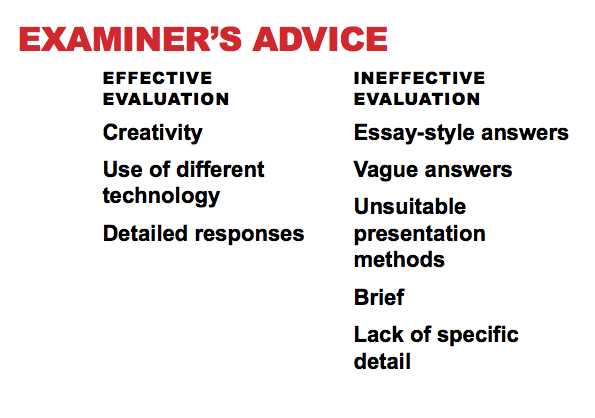
The moderator's report on last years student evaluation questions commented that the evaluation answers could have been done in more detail. As stated at the start of the blog - you will need to out at least 5 hours work into each answer to create even a basic sense of depth. See the moderator's comments below:


In the evaluation component, it was pleasing to see that the majority of candidates presented responses to the seven set questions and had embraced the use of digital technology in order to do so, some in a highly creative and engaging manner. The more successful candidates had clearly evaluated in detail using an analytical approach alongside creativity. Candidates could increase the depth in some responses, with answers to understanding issues around representation an area to consider developing in the future, candidates could be encouraged to deconstruct representation in terms of gender, age, ethnicity etc. as well as social sub groups.

Look at Pete Fraser's Guide to answering these questions:
http://petesmediablog.blogspot.co.uk/2010/11/evaluation-for-ocr-coursework.html

Levelling of Evaluation

MEL TO ADD OWN EVALUATION HELP SHEET HERE GIVEN TO STUDENTS LAST YEAR

Level 1  0–7 marks

Minimal skill in the use of digital technology or ICT in the evaluation.
Minimal understanding of issues around audience, institution, technology, representation, forms and conventions in relation to production
.Minimal ability to refer to the choices made and outcomes.
Minimal understanding of their development from preliminary to full task.
Minimal ability to communicate.

Level   8–11 marks

Basic skill in the use of digital technology or ICT in the evaluation
Basic understanding of issues around audience, institution, technology, representation, forms and conventions in relation to production.
Basic ability to refer to the choices made and outcomes.
Basic understanding of their development from preliminary to full task.
Basic ability to communicate.

Level 3  12–15 marks
Proficient skill in the use of digital technology or ICT in the evaluation
Proficient understanding of issues around audience, institution, technology, representation, forms and conventions in relation to production.
Proficient ability to refer to the choices made and outcomes.
Proficient understanding of their development from preliminary to full task.
Proficient ability to communicate.

Level 4  16–20 marks

Excellent skill in the use of appropriate digital technology or ICT in the evaluation
Excellent understanding of issues around audience, institution, technology, representation, forms and conventions in relation to production.
Excellent ability to refer to the choices made and outcomes.
Excellent understanding of their development from preliminary to full task.
Excellent ability to communicate


Evaluation Help


Before you start these seven questions go through my blog and look at the text at the top of each post that is in orange e.g
This post relate to the evaluation question:

4. Who would be the audience for your media product?
5. How did you attract/address your audience? 
This summarises the posts that you have completed that will support you in answering these 7 questions. Use your posts to help (not mine) - even consider the media theorists you have looked into as this may well bring you extra marks if you relate the theorists back to your own OTS and what you have learnt.

Then look at this OCR exemplar of student's work:
'B' grade student
to see what she has done. The moderator said about it:
"Clear responses, but the answers on ocassions read like an essay rather than taking advantage of using digital technology to help with the answering of these questions."
This is why she got a 'B' rather than an 'A'.

Also look at 'B' grade KLS students from last year:
Fateh Khaled
Kelly Simpson
Daniel Bruce

I have written to OCR for exemplars from students who have achieved an 'A' for these questions, but unfortunately they were unable to provide these resources - this means you will need to consider a combination of my notes in the Scribd document above, the KLS exemplars which did well with technology but less well in their depth of response and the exemplar OCR student response that didn't fair so well on their use of technology, but did manage to answer the questions well.
I have also added some power points below which will help support you in this exercise.

The information in the Scribd document above is a help sheet to guide you through answering the 7 questions. This MUST be read.


The 2 power-points directly below answer this question in very different ways - I think the two ways could be combined for a really strong answer.


As Question1presentationmedia

This is really thorough - some bits are relevant to you and other bits possibly more detailed than required. 

I really like this presentation to help with the answering of question 1. Although much of it doesn't relate (as they did a slightly different task to us), what is really helpful is how organised they have been in answering the question and also that they have been particularly imaginative in colour coding their screen shots so that there is differentiation between scenes where conventions have been met, broken or developed.

Put Your Prelim Task Film Here

Post Your Final Film Here